



FAQ
Q. 1 How does the Solar Water Heating System heat water?
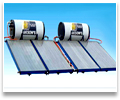
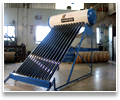
Ans 1 - The main part of the Solar Water Heating System is the Flat Plate Collector or in common parlance 'PANEL'. Metallic strip (mainly of Copper) is coated with thin layers of Nickel and Chromium, which is called as Solar Selective Coating. This selective coating ensures highest degree of absorption of Solar Heat and least possible emission of the same. This results in optimal utilization of the Solar Heat. This component, which is the heart of any Solar Heating System, is known as Absorber Fin.
In every Flat Plate Collector (panel) there are number of such absorber fins, which are connected on both sides to copper pipes known as headers. The heat collected by the Absorber Fin is transferred to the liquid flowing through the tubes / pipes. The liquid so heated becomes lighter & is pushed up by the cold water at the bottom helping it fill the Hot Water Storage Tank. Thus the cold water is continuously heated and collected in the Hot Water Storage Tank throughout the day. This is on the basis of natural thermo-siphon.
Q. 2 Whether the water heated during day remains hot throughout the night?
Ans 2 - The Solar Flat Plate Collector is provided with insulation, which prevents heat loss. Similarly the Hot Water Storage Tank and the pipes carrying water upto user point are also properly insulated. This ensures minimum drop in the temperature of the hot water. As a result, you get hot water even on cold mornings.
Q. 3 What are the applications of SWHS?
Ans 3 - The main use of hot water is for bathing. It is also used for washing of clothes and utensils to help less consumption of soap and detergent to get rid of stubborn dirt and grime. To cleanse floors and
disinfect surroundings with added dermicides. It can also be used for preheating to save fuel and electricity to raise the temperature of normal or below normal cold water. The Users could be Homes, Hospitals, Hotels, Hostels, Industries, Laboratories, Laundries etc?
Q. 4 What is the difference between Solar Water Heating System and a
metal utensil?
Ans 4 - Metal utensil gets heated in the sun but due to the emission of heat gets cooled fast. Heart of the Solar Water Heating System, THE ABSORBER due to the selective coating results in absorption of
maximum heat and loss of minimum heat due to emission. As a result the heat is retained effectively in the Solar Water Heating System as compared to any other uncoated Metal. This confirms that the efficiency
of Solar Water Heating System depends mainly on the quality of the absorber used.
Q. 5 Why are there complaints about the poor performance of Solar Water
Heating System? What are the reasons?
Ans 5 - There can be various reasons for poor performance of Solar Water
Heating System such as
The most important reason - low quality absorber.
The collectors are not installed properly to suit the latitude of your city. Dealers / installers lacking required technical knowledge about Solar Energy, not following the standards and having purely commercial attitude are responsible for this. Please ensure that dealer / installer has required knowledge.
We being in the Northern Hemisphere, Sun is in the south most of
the critical time. So the panels must be installed facing SOUTH
to gather maximum heat.
Care is not taken to ensure that the hot water does not get mixed
with the cold water.
Solar Water Heating System is of inadequate capacity. (Undersized
System.)
Continuous use of hot water over long period.
Lack of adequate shadow free space for installation.
Use of hard water having dissolved salts beyond acceptable limit
causing scaling and retardation of heat transfer process.
Inadequate head for the cold water storage tank resulting in
sluggish circulation.
Inadequate capacity cold water storage tank.
Poor quality insulation of storage tank and pipes.
Blockage of system due to sediments in the water.
Panel top glass not clean, affecting Solar Transmittance.
Q. 6 What are the benchmarks for selecting a Solar Water Heating system as there are number of manufacturers and dealers?
Ans 6 - Unfortunately today there is a plethora of manufacturers and dealers without required technical know-how and having no scruples, do it as a business as there is a good demand for Solar Equipments. These elements prosper due to total lack of information with the common man about the criterion for selection of good Solar Water Heating System. Similarly the habit of customers to give more weightage to only the price factor, without considering the technical features and life expectancy of the system, lands them with a poor quality system. Sometimes absence of adequate after sales service results in the entire investment getting wasted.
Solar energy is inexhaustible. Similarly Solar Water Heating System is a thing which one should have to buy once in a lifetime. Thus while selecting a Solar Water Heating System, one MUST evaluate the following factors before taking a decision.
Make of the panel. (By whom it is manufactured)
Which absorber is used in the panel? Whether the sheet and tube are welded / soldered or brazed together? Best results are obtained by TIG welded full length joint than any other method. To have the best ask for AKSON'S PVD Sunselect (TM) COATED absorber.
Construction of collector box. Check whether the gaskets and grommets are of EPDM.
The Hot Water Storage Tank. Ask for only Stainless Steel (SS 304/ 316 Grade), as it will mean service for lifetime. Ensure that the pipe fittings attached to the tank are also of SS 304/316 and are TIG welded. Some vendors tell interesting stories for selling systems with tanks of Mild Steel or even give SS tanks of inferior quality SS and non-SS fittings. These are normally the tactics used for showing a low price. Storage tanks other than of SS 304 of adequate thickness will tend to rust and may need a replacement after 4- 6 years costing around Rs. 6000/ for a 125 Ltrs. tank to be replaced by SS tank apart from the mental tension and running around. Some manufacturers use SS 202 grade, which is the Steel used normally for kitchen utensils. If this is used for tank, the tank can develop cracks any time. Some manufactures use SS 304, which is the ideal grade but use low thickness sheet. Similarly the fittings also should be of SS 304 grade. Some manufacturers use GI Fittings. Since the GI to SS welding is not proper the tank starts leaking after some time.
Some manufacturers use inadequate / improper insulation for hot water tank. This results in water temperature getting substantially reduced over night. The insulation should be adequate. For hot water tank the cladding after insulation should be of high grade Aluminium. It should be without joints. The round cover on both sides should be of aluminium and without joints. Plastic/ Fiberglass degenerates after 4-5 years. If there is a joint, cold air enters inside and brings down the temperature of the water.
The hot water pipe should be insulated with good quality insulation material.
If the piping is to be done by the seller, the pipes and fittings of reputed companies having a name for quality product should be insisted upon.
Valves should be of good quality with life long ease of operations.
Hot water tank should have a facility (socket) for fitting electrical heater.
Services the seller offers during the Guarantee Period should be examined.
Q. 7 How to install a solar heating system properly? What conditions should be fulfilled for it?
Ans 7 - Solar system should be installed with the panel at particular angle from the floor attitude/latitude of the city.
Panel should have proper & sturdy support on both sides. The entire system should be properly installed on the terrace/ platform. The installation of piping should start from collector side so that unnecessary pull and stress in avoided on that side. The collector should be installed on the southwest corner of the terrace with a slope on the south side.
The collector of the solar water heating system should be receiving the sun light minimum for 5.5hours per day. The cold water should be on minimum 2.5-meter elevation from bottom of the panel. Proper vent should be provided for releasing the steam/air trapped in the system. The piping should be properly examined after installation to ensure that there is no leakage before insulating. There should be a good quality non-return valve to ensure that hot & cold water does not mix. While installing the hot water tank on the stand, proper care should be taken to ensure that no stress develops on the welded portion.
Q. 8 - Are there any rules to ensure optimum utilization of solar water heating system?
Ans 8 - While selecting water-heating system your needs and usage habits should be taken into account.
In conventional thermo-siphon system for proper flow of hot water in the pipe equivalent amount of cold water should go into the hot water tank. Hot water should be used keeping this in mind.
The glass on the panel should be kept clean.
Overhead cold water tank should always have water.
Q. 9 - What is the basic difference between solar thermal energy and solar electric energy? Whether it is possible to produce electricity from the Solar Water Heating System?
Ans 9 - Solar Thermal Energy is used for heating by absorbing the heat from Sunlight. Converting Sunlight into electricity produces solar electricity. Solar heating system cannot be used to produce electricity at present.
Q. 10 What is the expected life of a solar water heating system? What does it depend upon?
Ans 10 -The life of solar water heating system depends on the absorber, the construction of the collector, quality of hot water tank & insulation etc. As mentioned above, a M. S. tank may get rusted & start leaking
after 4-5 years, thereby resulting in lot of headache & expenditure for replacement. An ideal solar water heating system should have high quality panel, stainless steel (SS 304) tank, good quality pipes of standard make & proper insulation. These things along with use of soft water ensure a long life of system. Absorbers manufactured with the existing technology
go through the coating processes at 28 degree Celsius temperature. If the cold-water tank remains empty during the day (which possibility cannot be avoided completely), temperature of approximately 180 degree Celsius is created in the collector This causes the coating at the absorber to weaken. This results in the reduction of effective life of solar water heating system.
In Aksons? PVD Sunselect (TM) coating process, we heat the absorber material to 300 degree Celsius while applying the solar selective coating on it. Thus our absorber retains its efficiency and the coating even after going through the temperature of 180 degree Celsius for hundreds of hours. We believe that the solar water system manufactured according to our technical benchmark and having our absorber will have a life span of more than 25-years.
Q. 11 What is the maintenance cost of a solar water heating system?
Ans 11 - A technically sound system installed by skilled technicians coupled with usage of water having salt contents of less then 100ppm will require minimum maintenance. In this situation the only maintenance work, which can easily be done by any common man, is removing the dust on the glass of panel. If there are sediments / impurities in the water, remove the nut-bolts of flange of header below the panel to let the water and impurities go out. If the water contains dissolved salts more than 100ppm then you will have to use water softener or you have to cleanse the system with water mixed with acid after certain period. After 7-8 years the rubber parts of the collector are advised to be replaced. Please ensure that the silicon sealant is reapplied every 4-5 years to avoid leakage of water in the collector. Electrical components of a forced circulation system may need repairs replacement. Therefore before buying a solar water heating system you have to find
whether the seller offers such service. Apart from this no other maintenance is required. For forced circulation systems, electrical maintenance may be required.
Q. 12 How is the capacity of a Solar Water Heating System decided?
Ans 12 - Generally cold water at 20 degree is converted to hot water at 60deg. For this, assuming average availability of the sunlight for 5.5hrs/ day the capacity of system is decided. For deciding the required capacity of Solar Water Heating System, habits of usage of hot water, number of persons in the household etc. need to be taken into account.
Q. 13 What is certified 'ISI' marked Solar Water Heating
System?
Ans 13 - To protect the interest of consumer and ensure proper return of their money the Bureau of Indian Standards (BIS) benchmarks certain standards for every item. Based on these quality standards a License to manufacture is issued& the collector confirming to BIS 12933 - carries ISI mark.
Q. 14 What is the secret behind the Solar System available for very low price? What are the deficiencies in it?
Ans 14 - Very attractive low price, misleading advertisements and verbal assurance by the seller lands one with low quality system. There are systems available in the market at very low prices. In these the material used is unproven, very low quality without any scientific/technical base. These systems supplied at 50% of price have only 50% efficiency and 20-25% life span as compared to a good Metallic Solar Water Heater System. Thus the value for money is only 12.5%. In case of systems using low quality material and sellers who just assemble & sell, once the money is received the guarantee is over.
Some of them are not knowledgeable and some are downright cheats, so choose carefully.
Q. 15 Is there any subsidy for Solar Water Heating System? What are the details?
Ans 15 - as per the present Government policies for Solar Water Heating System loan at subsidized interest rate is given.
Instead of cash subsidies for upto 5000 liters/day capacity system for domestic use a loan upto 75%of price is given at 5%per annum interest rate. The installment per month comes to Rs.19.20 per thousand per month. But for this there are some preconditions.
Q. 16 How to decide the right price of Solar Water System?
Ans 16 - The selection of system should be done based on the proper technical specifications. The system adhering to these specifications with most competitive price should be chosen.
Q. 17 How to ensure safety in the Solar Water Heating System?
Ans 17 - The cold water tank should be full otherwise the steam generated can cause accident. The water coming from pipe is hot and can cause burn so you should not take both directly under the pipe/ shower without a good quality mixer.
Q. 18 - What is the maintenance for the system?
Ans 18 - As explained above, a solar system selected on the basis of the technical specification needs very little maintenance. But if the water is hard, acid cleaning is required periodically. You should find out whether the dealer has the required knowledge & material for this. Similarly parts made of rubber get damaged & need to be replaced. This should be kept in mind, while selecting solar system. For large size systems, electrical maintenance may also be required.
Q. 19 What is the warranty of Solar Water Heating System? What is its period?
Ans 19 - The manufacturer /dealer takes responsibility for the material used in the system & its workmanship for a period called as warranty